
Responsible Drinking and Marketing
Carlsberg Malaysia Group’s approach in managing Responsiblei Drinking and Marketing:
Own Operations: Ensuring strong governance over responsible drinking and marketing practices, including controls that prevent inappropriate placements of products/advertisements and uphold compliance with regulatory and internal standards
Value Chain: Enforcing strict compliance requirements for agencies, distributors and retail partners, applying age gating and brand safety controls across all consumer touchpoints, and integrating these risks into our sustainability risk management process
7.1 GOVERNANCE
1. Policy Framework and Oversight
• Governance of Responsible Drinking and Responsible Marketing is anchored in two core policies: the Responsible Drinking Policy (RDP) and the Marketing
Communication Policy (MCP), both of which establish mandatory standards for conduct, communication and compliance across the organisation.
• The DCP and MCP, governed at the Carlsberg Group level and applicable to all markets, outlines strict requirements for responsible consumption, sales
and marketing and defines governance roles, annual training obligations and escalation protocols for non-compliance. Both policies are enforced in alignment with regulatory requirements, and where local laws are stricter, those supersede Group policy.
2. Responsible Drinking Governance
• The RDP establishes clear behavioural expectations, workplace alcohol guidelines and defined responsibilities for all employees, supported by
disciplinary measures that align with national labour regulations.
• Our responsible consumption commitment is governed through structured programmes, including the #CELEBRATERESPONSIBLY campaign and
partnerships with retailers, ride-hailing operators and concerts promoters to advance responsible consumption.
3. Responsible Marketing Governance
- The MCP’s eight governing principles ensure our brand communications appeal only to legal age audiences, reinforce moderation, prohibit irresponsible depictions of alcohol use and mandate transparent product messaging.
- Age gating standards, placement controls and responsible content requirements, such as mandatory responsible drinking advisories, are consistently applied across all digital marketing.
- In Malaysia, we are also guided by the Malaysian Communications and Multimedia Content Code, under the Communications and Multimedia Act 1988, while in Singapore, we adhere to the Singapore Code of Advertising Practices, under the administration of the Advertising Standards Authority of Singapore.
4. Standardised Communication Controls
- All consumer touchpoints incorporate national legislation and guidelines, such as drink driving prevention messages, legal purchasing age restrictions and #CELEBRATERESPONSIBLY tagging that emphasises the importance of moderate consumption.
- These safeguards ensure consistent and compliant communication across markets and platforms.
5. Integration Into Enterprise Risk and Compliance Management
- Responsible Drinking and Responsible Marketing form part of Carlsberg Malaysia Group’s sustainability-related risk considerations under IFRS S1, monitored through quarterly risk registers and internal reviews.
- Biannual audits and monitoring exercises ensure adherence to communication standards, identify gaps and drive continuous improvement.
7.2 STRATEGY
#CELEBRATERESPONSIBLY is the umbrella campaign for all responsible drinking efforts and has been running for over 10 years. It aims to change consumer mindsets and behaviour regarding responsible enjoyment. This strategy is divided into three main categories — Marketing Campaigns, Events & Engagement, and Strategic Partnerships, specifically with ride-hailing companies. Generally, these activities are targeted to advocate for brand recognition with responsible consumption, the association of the brand with lifestyle activities and responsible consumption, respectively.
Under Marketing Campaigns, RM4.78 million was spent in 2025 on advertising and marketing efforts across print and digital media in Malaysia.
• We further invested in subscription to tools to ensure safety tracking, measuring and ad exclusion protocols. As per the Carlsberg Group’s global protocol, we adhered to strong brand safety measures using tools such as Google’s DoubleVerify to ensure safe ad placements across our media. This third-party ad verification platform checked whether our digital ads were delivered safely, correctly and effectively, preventing them from being advertised insensitively on social media
o For instance, we previously encountered a situation where a terminated agency failed to follow our advertising exclusion protocol, resulting in one of our ads being placed insensitively beside the the tragic news about a football player’s death — an issue of particular concern, given Carlsberg brand’s strong association with football. While the monetary impact was relatively small, the potential reputational harm among consumers who are loyal to the football club was a significant concern. Therefore, in order to avoid future cases such as this, we undertook the following mitigation actions:
-
prioritising publishers with higher brand safety controls or aligned risk tolerance;
-
engaging with publishers capable of section-level targeting to avoid high-risk content.
Where such targeting was not possible, we excluded the publisher entirely to avoid potential negative ad placement; and - exploring tech solutions that offered real-time content scanning and blocking.
Events & Engagement consist of marketing activations organised by Carlsberg Malaysia. A total of RM1.93 million was spent to ensure the following events adhered to local regulatory requirements:
-
In 2025, we organised four external events: CarlsCrib, World of Smooth, 1664 Bon Appétit-lah and Connor’s Experience in Malaysia
From the total RM1.93 million spent, a portion of the spending
was allocated to:
-
Breathalysers totalling to RM6,000, making them available not only at our external events, but also internal ones such as our brewery visits. This was to further promote our no-drinking-and-driving behaviour by
ensuring consumers understand the national permitted Blood Alcohol Content (BAC) limit of 0.05%. -
Further promote responsible drinking at our events and engagement, whereby we spent RM0.04 million on non-alcoholic beverage (Somersby 0.0) sampling for our events.
The last category of Responsible Drinking and Marketing is our Strategic Partnerships specifically with ride-hailing companies, which targets a very critical social concern about alcohol consumption: the inability to drive once inebriated. In 2025, the total expenses was RM0.02 million, although the cost might be insignificant, it was an effective partnership opportunity that we will consider exploring with other designated driver service operators, such as Buddy Driver (via Trevo app), MyDriver Malaysia, Drive Mate Services and
VDrive, particularly since the inconvenience of leaving a car behind after unplanned excessive drinking is a known cause of drink driving.
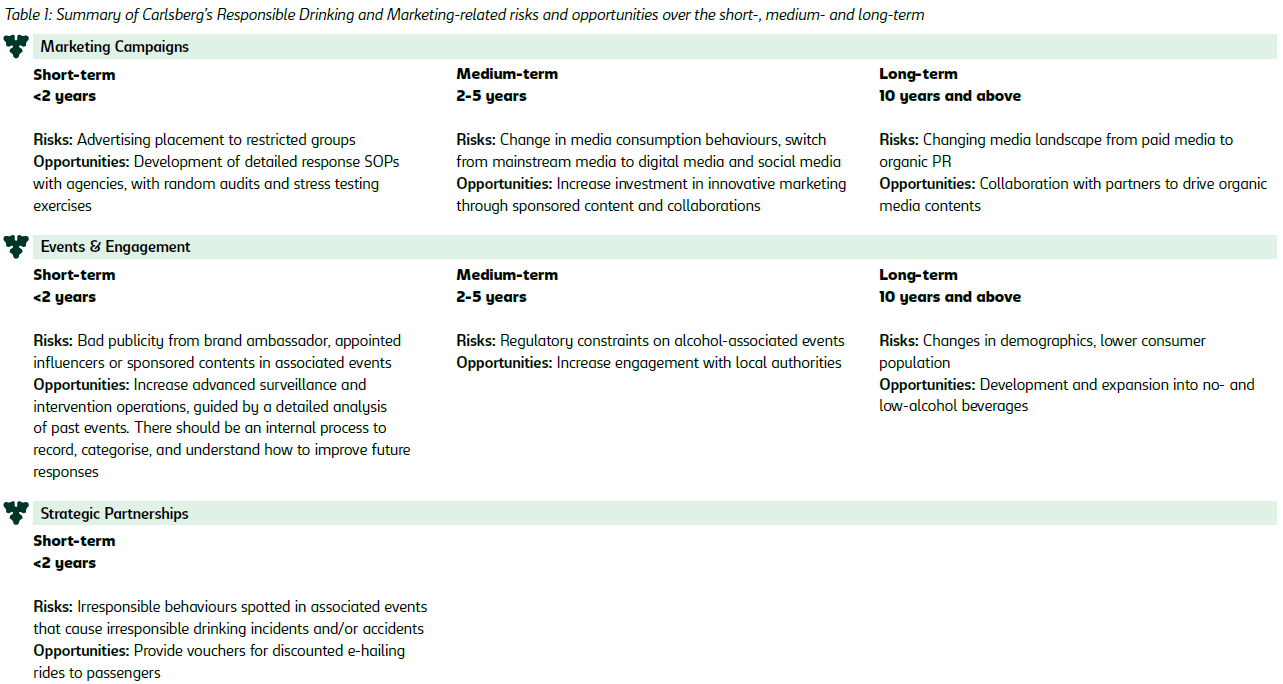
In summary, Strategic partnerships with ride-hailing and designated driver services might be the most effective area in addressing risks and opportunities through our Responsible Drinking and Marketing efforts. In the table below, we summarise Carlsberg’s Responsible Drinking and Marketing-related risks and opportunities over the short-, medium- and long-term.
7.3 RISK MANAGEMENT
7.3.1 Marketing Campaigns
Our MCP remains a key guideline for all employees, affiliated agencies and contract workers who are communicating through or on behalf of our brands. This includes media agencies, our current serving social media and creative agencies, as well as all our existing Key Opinion Leaders (KOLs). It is essential that everyone involved in marketing efforts adheres to the MCP. We provide a comprehensive briefing to communicate the policy effectively and share a reference copy during agency pitches or when onboarding a vendor.
We also tailor the MCP to meet the specific requirements of local markets, ensuring relevance and compliance. For instance, the MCP provides guidelines to govern alcoholrelated advertisements, posts and videos across our operations in Malaysia and Singapore. This includes ensuring alcoholrelated advertisements must not encourage drinking while at work or in situations or locations where it could lead to unsafe or unwise behaviour. In addition, we strictly prohibit promotions of excessive alcohol consumption.
In Malaysia, the MCP guidelines ensure that the intended audience does not include anyone below 21 and those of the Islamic faith. In Singapore, the drinking age is 18 years old and above. The content of brand communications, product packaging and marketing must also include a responsible drinking message, advice notices and the Don’t Drink and Drive logo and be age-gated wherever possible. We collaborate only with KOLs who are at least 25 years old and visibly reflect their age.
Our Legal Department regularly reviews marketing materials to ensure continued compliance with the MCP. Our respective brand teams are accountable for addressing any gaps promptly, with verification of closure from the Legal Department. As of 31 December 2025, there were no pending issues documented.
The following steps were carried out to validate all marketing materials prior to distribution according to the governance process below:
- Brand team reviewed externally developed marketing materials
- Verified by Marketing Manager
- Approved by Marketing Director
- Cleared by Legal & Compliance Director and Corporate Affairs ando Sustainability Director
In 2025, we continued to use Google’s DoubleVerify for our brand safety monitoring system to track all digital media buys, monitor unsafe advertisement placements and measure advertisement delivery across the web. DoubleVerify enhanced the process by categorising risks into three tiers: High, Medium and Low. This provided greater flexibility in assessing content, topics and webpages based on their risk level.
7.3.2 Events and Engagement
We adopted a structured risk mitigation process to ensure that all marketing activations were conducted safely, responsibly and in full compliance with regulatory and internal requirements. Before each event, the team secured all necessary permits from the relevant authorities and conducted due diligence on appointed event agencies, including pre‑screening for any adverse media or compliance concerns.
During the event, multiple safeguards were implemented to ensure participation was limited strictly to legal‑age, non‑Muslim consumers. This included mandatory pre‑registration as an initial eligibility filter, followed by on‑site verification through NRIC or passport checks to confirm the eligibility of individuals to consume alcohol under local laws during the event.
To further protect consumer safety and uphold security standards, all entry points were supported by metal‑detector screenings, bag and body checks to prevent the entry of prohibited items, such as weapons or illicit substances. Through this multi layered process, we reinforced our commitment to responsible drinking, regulatory compliance and safe consumer engagement.
7.3.3 Strategic Partnerships
Our strategic partnerships, specifically with ride-hailing platforms, to extend our brand’s reach also introduces shared risks. Before onboarding any new strategic partners, we conducted due diligence, including a review of the potential partner’s own governance structure, safety protocols (e.g. driver training and background checks) and historical incident data related to alcohol promotions.

Central & Eastern Europe and India
-
Azerbaijan
-
Belarus
-
Bulgaria
-
Canada
-
Croatia
-
Estonia
-
Greece
-
Hungary
-
India
-
Italy
-
Kazakhstan
-
Latvia
-
Lithuania
-
Serbia
-
Ukraine